

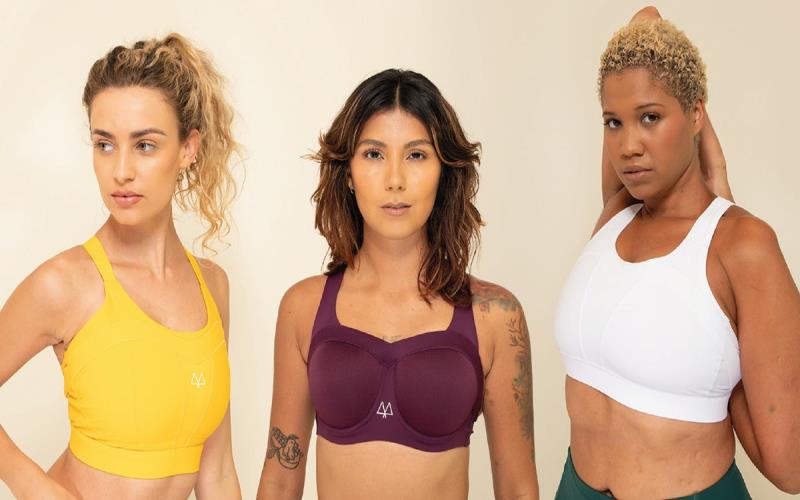
During your intense workout class, breaking a sweat and pushing your limits, the last thing on your mind should be whether your breasts are staying in place.
This is where the importance of the right sports bra becomes evident.
Research indicates that during activities like running, breasts can move up to 8 inches! Their movement often follows a figure-8 pattern, pulling them in various directions – up, down, backwards, forward, and side-to-side.
This blog will navigate you through the various styles and types of sports bras in detail and depth. Continue reading to learn more!
Understanding Sports Bras: How They Differ from Regular Bras
Sports bras are specially designed for workouts, providing added support, minimising breast movement, and effectively managing moisture. They stand out from regular bras because they aim to prevent breast movement during physical activities. Unlike typical bras that mainly counteract gravity, sports bras are crafted to keep your breasts from bouncing in various directions.
These bras use comfortable materials like moisture-wicking microfiber and terry linings, ensuring they handle sweat better than popular materials like nylon and satin in regular bras. You can fully focus on your workout, burpees or planks with no chafing or discomfort.
Different Types and Styles of Sports Bras
Sports bras fall into three main categories:
● Compression Sports Bras
- These bras compress or push your breasts against your body, offering effective support, especially for A, B, or C cup sizes.
- Wire-free designs make them comfortable, but be cautious of the potential “uni-boob” effect and chafing for larger busts.
● Encapsulation Sports Bras
- Featuring a cup for each breast, often with an underwire, encapsulation bras separate and hold your breasts individually.
- They are ideal for high-impact workouts, as they eliminate bounce and reduce strain, contributing to long-term breast perkiness.
● Encapsulation-Compression Sports Bras
- Combining the compression and encapsulation styles, these bras push your breasts against your body while providing individual cup space.
- It is well-suited for athletes of all sizes, particularly those with DD+ figures, as it offers structure and support through underwires.
● Regular Back Sports Bras
- Features a conventional ‘H’ or ‘regular’ back design, resembling the typical structure of your everyday bra. The shoulder straps run straight over your shoulders and down the back, offering ease of wear akin to your standard bra.
- This style typically incorporates a hook and eyelet closure for secure fastening.
● Racerback Sports Bras
- Characterised by a fixed point at the back where the shoulder straps converge. This design enhances back support and benefits women with sloping shoulders, preventing the straps from slipping.
- The streamlined back of a racerback sports bra also facilitates easier concealment of straps beneath your outer gym wear, ensuring a sleek and seamless appearance.
● Cross or ‘X’ Back Sports Bras
- The straps of this sports bra style are crossed at the back.
- Similar to the racerback design, it proves advantageous when worn under a racerback vest, as the straps remain unseen.
● Convertible Sports Bras
- This style offers versatility by allowing you to switch between a regular back or racerback, providing the benefits of both designs.
- The bra straps feature a small clip that will enable them to be fastened together. While adjusting may be slightly challenging initially, it usually becomes an easy transition once familiar.
The Bottom Line
We trust that this blog has been informative and aids you in making an informed decision when selecting your sports bra, a choice as personal as picking out your sports leggings for women. Remember, your choice of sports bra plays a significant role in providing the support and freedom of movement for an effective and enjoyable exercise routine.
