

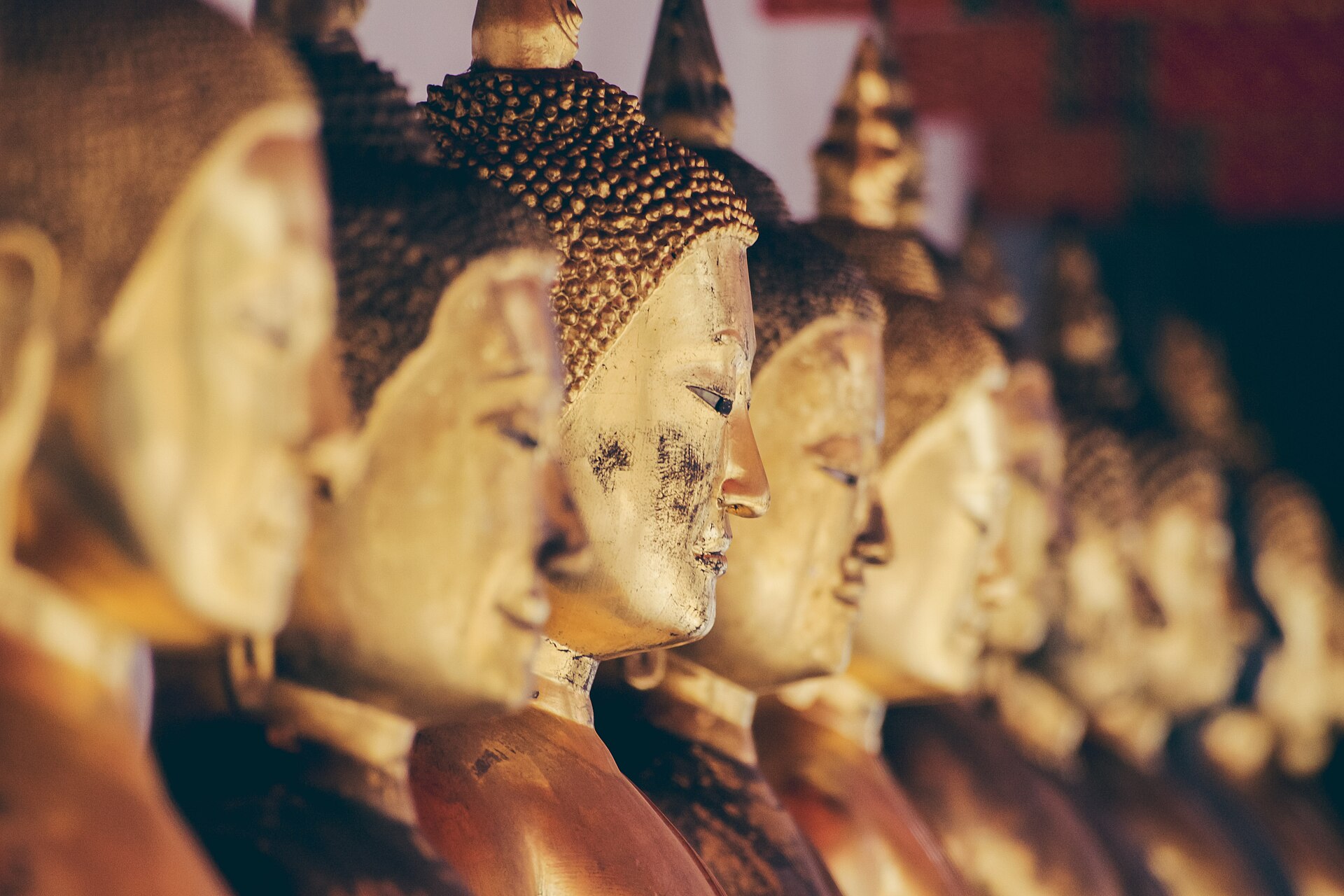
People often ask whether Buddhism worships a god, and the question usually comes with two boxed answers: one god or many. If you’re comparing buddhism monotheistic or polytheistic, the honest answer is that it’s neither. Buddhism is generally described as non-theistic, meaning its core teachings don’t rely on a creator god at all.
What monotheistic and polytheistic mean
Monotheistic religions, such as Judaism, Christianity and Islam, center on one God who created and rules the world. Polytheistic traditions, including ancient Greek religion and many forms of Hinduism, recognise multiple gods with different roles.
Both labels assume that the divine sits at the heart of the religion. Buddhism starts somewhere else.
What the Buddha actually taught
Siddhartha Gautama lived in northern India roughly 2,500 years ago. He didn’t present himself as a god or as a messenger from one. He described himself as a person who woke up, which is what “Buddha” means, and he taught a way of ending suffering through understanding and ethical living.
The heart of that teaching is the Four Noble Truths: life includes suffering, suffering has causes, it can end, and there’s a path that leads to its end. That path, often called the Eightfold Path, covers things like right view, right speech, right action and right mindfulness. Notice there’s no commandment to worship anyone. The focus is on practice and insight.
So do Buddhists believe in gods at all?
This is where it gets interesting. Many Buddhist traditions do include gods, spirits and celestial beings. In Buddhist cosmology, those beings live in higher realms, but they’re not creators and they’re not saviours. They’re subject to birth, aging and death like everyone else, and they still need enlightenment.
That’s why scholars often say Buddhism isn’t polytheistic in the usual sense. Those beings aren’t the object of the religion. Meanwhile, it isn’t monotheistic either, because there’s no single creator who rules the universe.
Differences across traditions
Buddhism isn’t one uniform thing. A few examples show how varied it is:
- Theravada, common in Sri Lanka and Thailand, stays close to the early teachings and focuses on personal practice.
- Mahayana, found in China, Japan and Korea, honours many bodhisattvas, compassionate beings who delay their own enlightenment to help others.
- Vajrayana, associated with Tibet, uses rich ritual and a large cast of deities as meditation aids.
In everyday practice, someone might bow to a statue, light incense or chant. Many Buddhists describe these as acts of respect and reflection rather than worship of a god. Others, particularly in some devotional traditions, relate to figures like Amitabha in a way that feels more devotional. So lived practice can look different from the textbook picture.
Why “non-theistic” fits better
The word non-theistic means that belief in a god isn’t required or central. You can be a Buddhist and hold varied views about gods without breaking the core teaching. The Buddha himself reportedly declined to answer speculative questions about the origin of the universe, calling them distractions from the practical problem of suffering.
Some people prefer the term “atheistic” for Buddhism, while others find it too blunt, because many traditions do speak about spiritual beings. “Non-theistic” tries to capture that middle ground.
A simple example
Think about a student visiting a temple in Kyoto. They see people bowing before a Buddha statue and assume it’s like praying to a god. A monk might explain that the bow shows gratitude to a teacher and a reminder to cultivate the same qualities. The statue represents an awakened person, not a creator who answers wishes.
If you enjoy quick breakdowns of “this or that” questions, compairro.com collects plenty of them in one place, which makes it handy for students and curious readers.
In short, Buddhism doesn’t fit neatly into either box. It’s best described as non-theistic, with a practical focus on mind, ethics and ending suffering rather than on worship of a creator.
